 |
 |
 |
http://www.varalaaru.com A Monthly Web Magazine for South Asian History [189 Issues] [1849 Articles] |
|
|
|
http://www.varalaaru.com A Monthly Web Magazine for South Asian History [189 Issues] [1849 Articles] |
|
Issue No. 187

இதழ் 187 [ டிசம்பர் 2025 ] 
இந்த இதழில்.. In this Issue..
|


Abstract In the historical urban center of Kumbakonam stands the Nageshwarar Temple, a significant architectural monument from the early Chola period. The temple's sculptural collection, which dates from around the 10th century CE, demonstrates the exceptional expertise of Chola artisans in producing architecturally integrated figural reliefs. Among the numerous miniature, kuta, and nasika sculptural units that articulate the vimana, the representation of the Vinadhara stands out as a distinguished example of Chola iconographic sophistication. The article investigates the sculptural panel's position, stance, imagery, artistic style, and technical details, including its current condition. 1. Introduction The Chola era represents a transformative period in South Indian temple architecture, defined by advancements in vimana design, sculptural symbolism, and iconographic variety. The Nageshwarar Temple, centrally situated in the historic settlement of Kumbakonam, displays an important array of figural reliefs that are characteristic of the early medieval Chola art period. Dating back to the 10th century CE, the temple is adorned with intricate miniature panels, silpa embellishments, and nasika motifs. The Vinadhara relief, situated on the south side of the first tier of the vimana's hara, holds notable artistic and iconographic importance. 2. Architectural Context and Placement The Vinadhara panel is situated on the southern side of the vimana, within the first-tier hara, and is incorporated into the sala–nasika projection. Placement within the bhadra zone of the wall illustrates a conscious architectural choice to use musical iconography to enhance the sacred vertical axis of the shrine's superstructure. 3. Description of the Icon 3.1 Posture and Seating The figure is seated upon a bhadra-piṭha covered with a sculpted textile drapery. The posture corresponds to utkuṭika asana, characterized by: • the left leg folded at the knee, • the right leg pendant, • the torso subtly rotated leftward, • and a downward, introspective gaze. The right foot rests lightly on a padapiṭha, reinforcing the compositional balance of the seated figure. The serpent, coiled beneath the folded left leg and positioned on the pedestal, is depicted in a poised and dynamic fashion, thereby contributing a symbolic layer to the scene. 3.2 Costume and Ornamentation The sculptor's ability to depict the costume and ornaments is characterized by an exceptional degree of accuracy and precision. • A kaṭi-vastra (loincloth) tied at the waist, its frontal drapery spread naturally over the pedestal. • Thal-seṛi (anklets) on both legs. • A udarabandha (abdominal girdle) encircling the torso. • A sacred yajnopavita rendered diagonally across the chest. • Kankana bracelets on the wrists, keyura armlets on the upper arms, rings on the fingers, and a savaḍi necklace on the neck. • The coiffure is arranged in an elaborate jaṭa-bhara (matted-hair assemblage). • The forehead bears an ornamented netri-paṭṭa with incised medallions. • An asymmetrical ear-ornament scheme is observed: • the right ear elongated in the classical style (Neel Sevi), • the left ear adorned with a palm-leaf ornament. 3.3 The Vina and the Gesture of Musical Performance 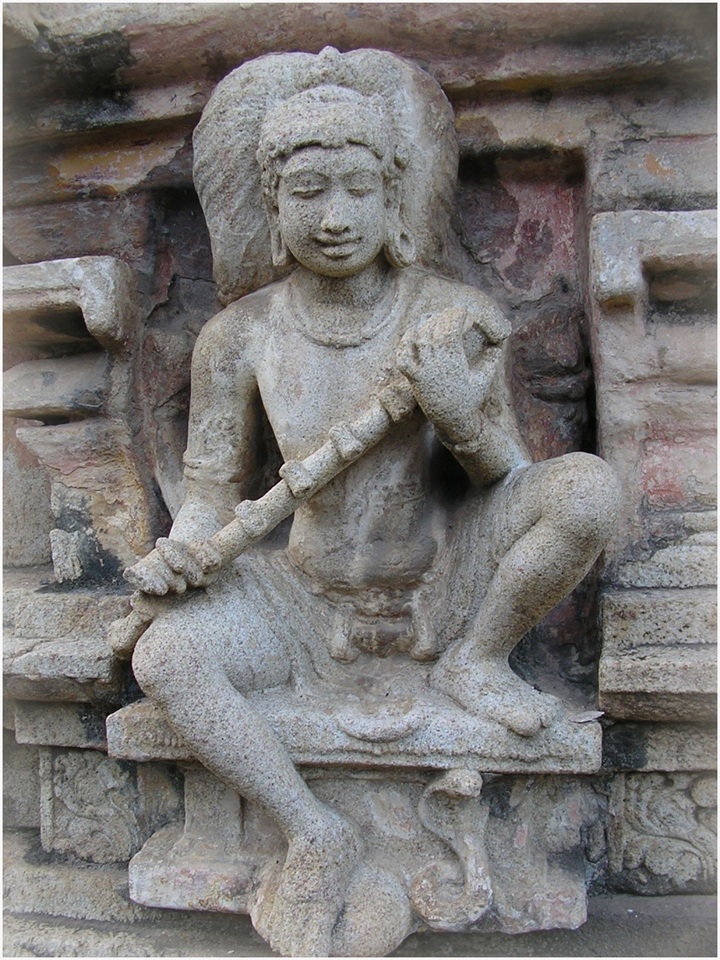 The vina is held by the two front hands: • The resonator (bottom of the Veena) rests on the right thigh. • The upper shaft is supported by the left palm and gently pressed to the chest. • The “kanus” (tuning pegs) are clearly sculpted along the upper part of the Veena. • The right hand displays a refined plucking gesture: • Middle and ring fingers engage the strings. • Index and little fingers are lifted slightly above the surface, indicating non-engagement. The way this minute is detailed is effective because it manages to convey the kinetic pause of a musician who is completely immersed in the process of sound production. 4. Psychological and Aesthetic Expression • The facial expression of the Vinadhara is a highly exceptional element of this relief, making it one of the most remarkable features. • The state of dhara-paryanta bhava(“An emotion or expressive state that extends from the ground upward through the entire body.”), which is a meditative absorption in music, is often evoked by half-closed eyelids. • A subtle parting of the lips, exposing the incisors along the sides, is a characteristic feature found in portraits created during the Chola period. • The transcendental experience of sonic bliss is captured by a faint smile that animates the visage. The Chola artisans' mastery of emotive stone modelling is exemplified by the rare psychological depth found in their small architectural sculptures. 5. Condition and Losses Although the sculpture is a testament to artistic integrity, it is, nonetheless, displaying observable weathering. • Due to the total loss of the left rear hand, the character of the object, which may have been an akṣamala or a naga, that it once held cannot be determined. • The right rear hand exhibits signs of partial erosion. • Examination reveals material loss present in the upper section of the vina, as well as the upper phalanx of the right index finger. • The existing erosion damage appears to be in keeping with the environmental conditions experienced over a period of hundreds of years. 6. Conclusion As a noteworthy example of the exceptional quality of Chola sculptures, the Vinadhara relief at Nageshwarar Temple is an outstanding artistic achievement. The artistic sophistication of early Chola craftsmen is confirmed by the refined iconographic detailing, architectural integration, psychological expressiveness, and technical virtuosity displayed in their work. The panel contributes to the aesthetic language of the temple’s vimana and also offers a source of information that will be useful for further studies in Chola music iconography, sculptural grammar, and architectural symbology. |
வீடியோ தொகுப்பு
Video Channel 
நிகழ்வுகள் Events 
சிறப்பிதழ்கள் Special Issues 
புகைப்படத் தொகுப்பு Photo Gallery 
|
| (C) 2004, varalaaru.com. All articles are copyrighted to respective authors. Unauthorized reproduction of any article, image or audio/video contents published here, without the prior approval of the authors or varalaaru.com are strictly prohibited. | ||
